
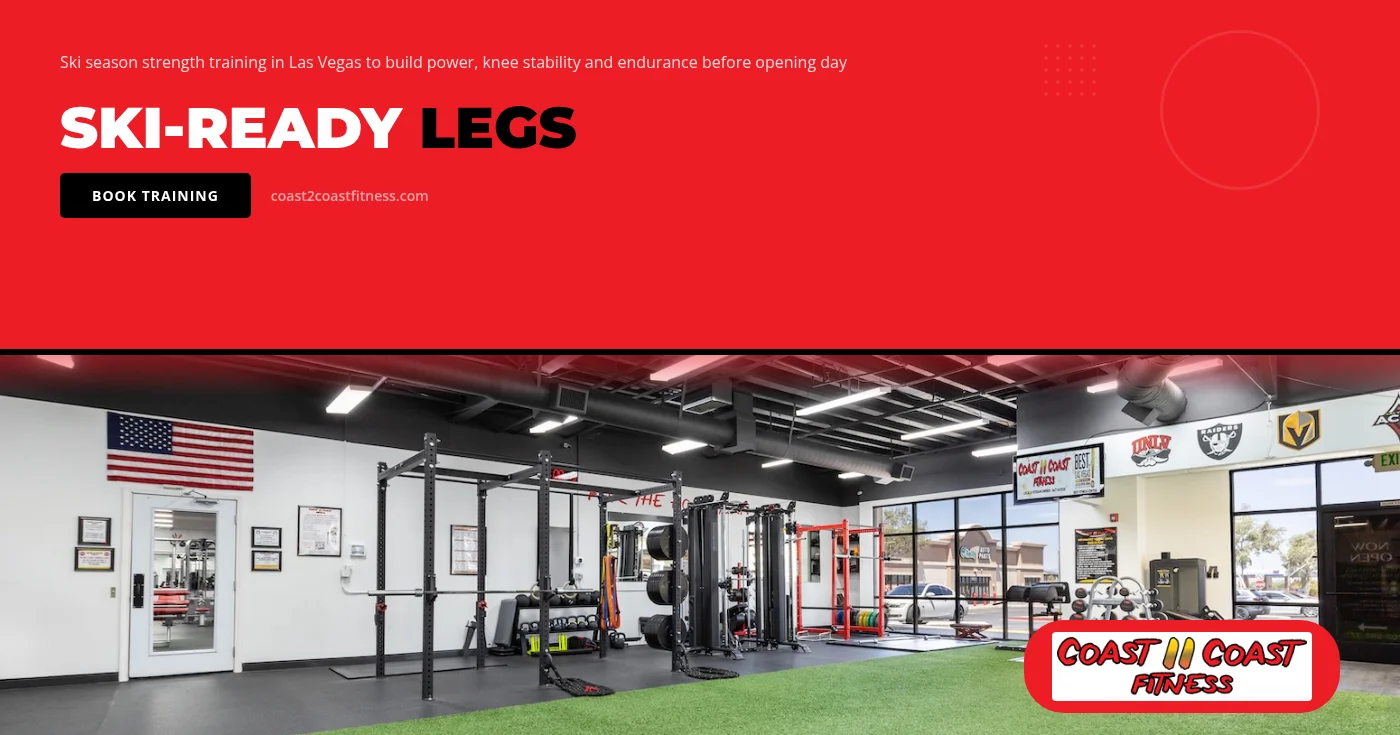
The first morning at Lee Canyon has a way of exposing every skipped leg day. A few runs in, your quads are on fire, your knees feel shaky and the mountain seems steeper than you remember. Here’s the good news: a few focused weeks of ski season strength training can change how that first weekend feels. Ski season strength training Las Vegas locals can fit around work, school and family doesn’t have to be complicated.
We’re lucky. Lee Canyon and the Mt. Charleston area sit less than an hour from home, so a powder day can start after breakfast. But that short drive takes you from the desert floor to serious altitude with almost no transition, and your body notices.
Here at C2C, we help skiers and snowboarders of every level get ready before the lifts start turning. In this guide, we’ll cover the muscles that matter most, a simple four-week plan, knee stability exercises, altitude-ready cardio, how we track progress and how to recover between mountain weekends.
Why Las Vegas Skiers and Snowboarders Need a Pre-Season Strength Plan
Skiing and snowboarding ask your legs to hold a bent-knee position for minutes at a time while absorbing bumps, ruts and sudden changes in snow. That’s not something most of us train for during a long desert summer spent dodging triple-digit heat. When we go straight from the couch to the chairlift, fatigue sets in early, form breaks down and tired muscles stop supporting the joints they’re supposed to protect.
Elevation adds another layer. The valley floor sits at roughly 2,000 feet, while Lee Canyon’s base is around 8,500 feet and its top elevation is roughly 9,400 feet, based on the resort’s published figures. Thinner air means your heart and lungs work harder for the same effort, so legs that felt fine in the gym can feel heavy by lunchtime on the mountain.
A pre-season plan gives you a buffer. Stronger legs fatigue more slowly, a trained core keeps you balanced when you catch an edge, and better conditioning means the last run of the day can feel as good as the first. In a short local season, every open weekend counts.
The Muscles That Do the Work on the Slopes: Quads, Glutes, Hamstrings and Core
Before you pick exercises, it helps to know what’s actually working when you carve a turn or ride through chop.
Quads: Your Brakes
Your quadriceps do most of the heavy lifting in a ski stance. They work eccentrically, lengthening under load as you control speed and absorb terrain. That’s why your thighs burn on long runs, and it’s why leg strength training should include slow, controlled lowering, not just fast reps.
Glutes and Hamstrings: Your Knee Supporters
Your glutes and hip abductors keep your knees tracking over your toes instead of collapsing inward, a position often linked to knee strain. Your hamstrings work alongside the quads to stabilize the knee and support the ACL. A strong posterior chain also takes pressure off your lower back when you’re crouched in a tuck or getting up after a fall.
Core: Your Steering Column
Your core connects everything. A stable trunk lets your legs react independently while your upper body stays quiet and balanced. Snowboarders lean on rotational core strength even more, since turns start with the hips and shoulders. That same rotational power is a big part of our golf instruction programs, so if you swing a club in the off-season, the carryover is real.
A 4-Week Ski-Ready Strength Conditioning Program You Can Start in November
Lee Canyon typically aims to open in late November or December, depending on snow and snowmaking, so starting in early November gives you about a month of focused work. Plan on three strength sessions a week with a rest day between them, plus cardio on separate days. It’s a pre-ski workout Las Vegas members can finish in 45 to 60 minutes.
- Week 1 – Foundation: Goblet squats, glute bridges, step-ups, planks and side planks. Three sets of 10–12 reps with moderate weight and a slow three-second lowering phase.
- Week 2 – Load: Add back squats or trap-bar deadlifts, Romanian deadlifts and walking lunges. Drop to 8–10 reps and increase weight gradually. Finish with a 60-second wall sit.
- Week 3 – Single-Leg and Lateral: Bulgarian split squats, lateral lunges, single-leg RDLs and Pallof presses. Build your wall sits toward 90 seconds.
- Week 4 – Power: Keep your main lifts, then add skater hops, box jumps and lateral bounds in short sets of 6–8 with full rest. Power work teaches your legs to react quickly to changing snow.
Ease off the volume a few days before your first trip up so you arrive fresh, not sore. If you’re new to lifting or coming back from an injury, check with your doctor first and scale the weights to where you are today.
Protecting Your Knees and Lower Back with Stability and Single-Leg Training
Knee injuries, including ACL tears and MCL sprains, are among the most common serious ski injuries, while snowboarders more often hurt their wrists and shoulders, according to the American Academy of Orthopaedic Surgeons’ OrthoInfo resources. Research on neuromuscular training, which combines balance, landing mechanics and single-leg strength, suggests it may help lower ACL injury risk. No program can promise you’ll never get hurt, but it can give your joints better support.
These knee stability exercises are worth building into every session:
- Single-leg balance holds: Stand on one foot for 30–45 seconds, then progress to an unstable surface or eyes closed.
- Lateral band walks: Keep tension on a mini-band to wake up the glutes that stop your knees from caving in.
- Single-leg RDLs: Build hamstring strength and hip control at the same time.
- Controlled landings: Hop and stick the landing softly, knees over toes, before progressing to bigger jumps.
- Bird dogs and dead bugs: Train the deep core muscles that support your lower back.
Quality matters more than quantity here. A handful of sharp, controlled reps beats a long set where your knees start drifting inward.
Building Altitude-Ready Endurance on the Cardio Floor
You can’t bring the mountain to the valley, but you can make your heart and lungs more efficient before you go. The CDC Yellow Book notes that altitude illness becomes more likely above roughly 8,000 feet, especially after a quick climb from low elevation, with symptoms like headache, fatigue and poor sleep. Fitness alone won’t prevent altitude sickness, but better conditioning can help you handle the extra effort of skiing in thinner air.
Our cardio equipment gives you plenty of options for ski-specific intervals:
- Stair climber: Mimics the sustained leg demand of a long run.
- Bike intervals: Try 40 seconds hard, 80 seconds easy, for 8–10 rounds.
- Rower: Builds full-body endurance and posterior-chain strength.
For snowboard conditioning, add lateral shuffles and short agility drills to train quick edge changes. Federal activity guidelines recommend at least 150 minutes of moderate aerobic activity a week, which is a smart baseline. And hydrate: dry desert air plus altitude is a fast track to dehydration, so start drinking more water the day before you head up. With 24/7 access, you can fit intervals in before work or after the kids are asleep.
How 1:1 Personal Training and InBody Testing Track Your Ski-Season Progress
A plan only works if you follow it with good form and keep progressing. That’s where personal training Las Vegas skiers can count on makes a difference. Our certified trainers build personalized programs around your ability level, goals and any old injuries, then coach every rep so you never feel lost on the gym floor.
Here at C2C, we pair training with InBody body composition testing. The InBody uses bioelectrical impedance to estimate skeletal muscle mass, body fat percentage and how lean mass is distributed between your legs. Those readings are estimates and shift with hydration, so we recommend testing under the same conditions each time, ideally at the same time of day before you eat or train.
Tracking gives you real feedback:
- See whether you’re adding muscle where skiing demands it most
- Spot imbalances between your left and right legs
- Adjust training and nutrition based on results, not guesswork
A baseline scan at the start of your four weeks and a follow-up before opening day shows how far you’ve come, while your trainer fine-tunes weights and exercises week to week so you keep moving forward.
Recovery Between Gym Sessions and Mountain Weekends
The pain you feel today is the strength you feel tomorrow, but only if you give your body time to rebuild. Hard weekday training plus hard weekend skiing can stack up fatigue fast, especially early in the season.
- Skip heavy legs before a mountain day. Schedule your toughest session early in the week and keep the day before your trip light or off.
- Use active recovery. An easy bike ride or walk on Monday helps sore legs more than sitting all day.
- Stretch and mobilize. Focus on hip flexors, quads, calves and your upper back.
- Refuel and rehydrate. Protein and water after a ski day support muscle repair, and our premium supplements can help fill gaps if you struggle to hit your protein goals.
- Sleep. Altitude can disrupt sleep, so prioritize rest once you’re back home.
Our Recovery Room gives members a dedicated space to cool down, loosen up and reset between sessions. Treat recovery as part of your program, not a break from it. The skiers who feel best in March usually respected recovery in November.
Frequently Asked Questions About Ski Season Strength Training in Las Vegas
How many weeks before ski season should I start strength training?
Four weeks is a solid minimum for noticeable gains in leg strength and endurance. Six to eight weeks is even better if you’re starting from scratch, but even two consistent weeks beats showing up cold.
Can I get ready for Lee Canyon if I only work out 2–3 days a week?
Yes. Two or three full-body sessions built around squats, hinges, single-leg work and core, plus some cardio, can make a real difference. Consistency matters more than volume.
Will altitude at Lee Canyon affect me if I live in Las Vegas?
It might. The climb from the valley is fast, and some people notice headaches or fatigue. Stay hydrated, pace your first runs and consider an early hike in the Spring Mountains to adjust. If symptoms get worse, head back down and talk with a medical professional.
Is strength training different for snowboarding versus skiing?
The foundation is the same, but snowboarders benefit from extra rotational core work, hip mobility and upper-body strength for getting up and bracing falls. Skiers often need more independent leg strength and lateral control.
Start Your Ski Season Strength Training in Las Vegas at C2C
Opening day will be here before you know it, and the work you put in now shapes how those first runs feel. Effective ski season strength training Las Vegas skiers and riders can rely on comes down to strong legs, stable knees, a solid core and the endurance to handle altitude. As a family and veteran-owned gym in Centennial Hills, voted Best Fitness Center in Las Vegas five years running (2021–2025), we’re proud to train members from Summerlin, Centennial Hills and communities across the valley. With 24/7 access, no contracts and no joining fees, getting started is simple.
Ready to build ski-ready legs? Contact us today to set up your first session, and let’s get you to the mountain stronger than ever.
Where Can I Get a Personalized Ski-Ready Training Plan?
Right here with us. At C2C, we build ski and snowboard conditioning plans around you, whether you’re gearing up for your first season or chasing faster laps on familiar terrain. Our certified trainers work with you 1:1, so every squat, lunge and balance drill is coached and adjusted to your level.
Here’s what we bring to your pre-season prep:
- Personal Training: Personalized programs that target leg strength, knee stability and core control for the slopes.
- InBody Body Composition Testing: Estimates of muscle mass and body fat so you can see your progress, including left-to-right leg balance.
- Performance Training Center and Cardio Equipment: Room for power work, intervals and agility drills that build altitude-ready endurance.
- Recovery Room: A dedicated space to cool down and reset between gym sessions and mountain weekends.
- Premium Supplements and complimentary bottled water: Support for refueling and hydration in our dry desert climate.
We’re a family and veteran-owned gym, and we’re honored to have been voted Best Fitness Center in Las Vegas five years running (2021–2025). With 24/7/365 access, no contracts, no joining fees and no annual fees, you can train on your schedule. We also offer family memberships plus military and student discounts, so the whole crew can get ready for the season together.
The pain you feel today is the strength you feel tomorrow. Reach out to our team and let’s start building your ski-ready strength this week.