
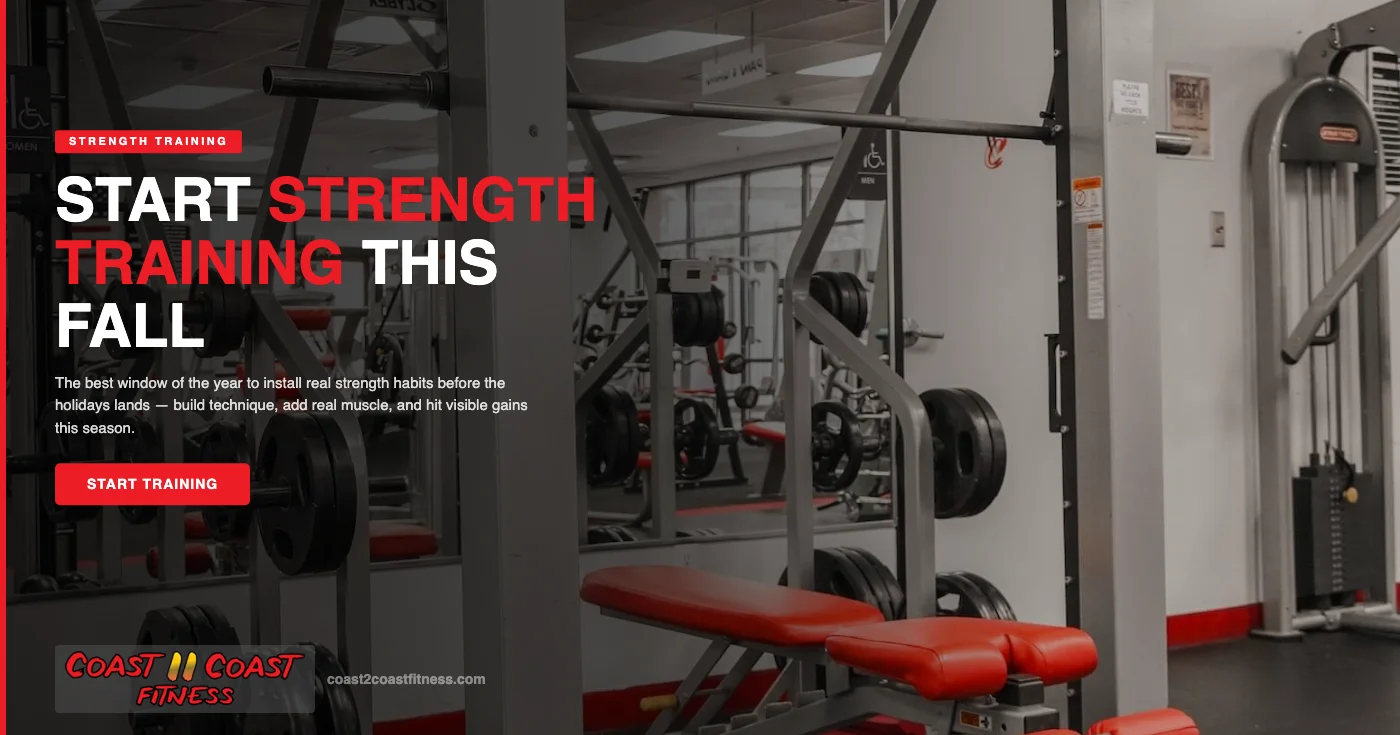
If you have been thinking about starting strength training in Las Vegas Valley, the calendar is finally on your side. September through November is the highest-leverage stretch of the year to walk into a gym for the first time — or reset a routine that fell apart during summer. The heat breaks, evenings cool off, school and work schedules stabilize, and the runway to the new year is long enough to build real habits and see visible results, not another January resolution that fizzles by February.
At Coast2Coast Fitness, our certified trainers see the same pattern every fall. Members who commit to a structured strength program in September build more momentum by December than the members who wait for a new-year resolution. This guide covers why fall works so well across the Las Vegas Valley, what strength training actually does, and how we build beginner programs that hold.
Why Las Vegas Valley Gym-Goers Restart Their Routines in Fall
Ask any long-time trainer when their calendars fill fastest and you will hear the same answer: mid-September through early November. Part of that is climate. Summer highs across the Las Vegas Valley routinely push past 105°F, and even a determined lifter usually cuts sessions short by August. Once daytime temperatures drop into the 80s and 70s and evenings become pleasant again, showing up at the gym stops feeling like a battle against the weather.
Part of it is behavioral. Kids are back in school, work schedules stabilize, and the natural end of "summer mode" gives most of us a clean line to reset off of. Behavioral scientists call this the "fresh start effect" — new seasons act like calendar milestones that make people more likely to commit to a new habit. Fall carries all the psychological weight of a January reset with a major advantage: you get ten to twelve weeks between now and the holidays. That runway is long enough to install real habits and hit a first round of visible strength gains before Thanksgiving. Members who train consistently through September, October, and November walk into the new year already ahead.
What Strength Training Actually Does for Your Body
Strength training is more than lifting heavier weights each week. It is the single most efficient way to change how your body composes itself, moves through daily life, and holds up over decades. When we take members through the basics, we frame it in four buckets.
First, lean muscle. Progressive resistance training raises your resting metabolic rate, which is why members chasing fat loss get better results from a strength-first plan than from cardio alone. Second, bone density. Loading the skeleton through squats, deadlifts, presses, and pulls stimulates bone remodeling and protects against age-related bone loss.
Third, movement quality. Everything you do outside the gym — climbing stairs, lifting groceries, hiking a Red Rock trail on a Saturday morning — is easier when the posterior chain is strong and the hips are stable. Weight training in Las Vegas Valley gyms carries over directly into how you feel outside the gym. Fourth, metabolic health. Strength work improves insulin sensitivity, lowers blood pressure, and supports cardiovascular fitness. The CDC recommends 150 minutes of moderate-intensity aerobic activity plus two days of muscle-strengthening work per week, and the strength piece is where most people fall short.
Building a Beginner Strength Program at a Las Vegas Valley Gym
A beginner strength program does not need to be complicated. It needs to be repeatable. The programs that transform new members over a fall reset almost always follow the same skeleton: two or three full-body sessions per week, built around a handful of compound movements, with a clear progression scheme so weight goes up over time.
The compound lifts that carry the most weight for a beginner are the squat, deadlift, bench press, overhead press, and row. Each one recruits large muscle groups and produces the biggest hormonal and neurological response for the time invested. A first program might look like squat, bench, and row on Monday; deadlift, overhead press, and pull-up work on Thursday — three sets of five to eight reps per movement for the first six weeks. The goal in that window is not to chase soreness. It is to build clean technique and add a small amount of weight each session while the nervous system adapts.
Assistance work — hip thrusts, split squats, dumbbell rows, curls, and core work — fills in around the compounds, always after the main lifts. Our certified trainers build the first eight weeks around this structure for almost every new member at our gym in Las Vegas Valley, then layer in more advanced volume and intensity once the basics are dialed in.
Common Strength Training Mistakes and How to Avoid Them
The fastest way to derail a fall reset is to make the same handful of mistakes we see every September. Watch for them.
Chasing weight over technique. New lifters routinely add load faster than form can catch up. A wobbly bar path or a hip shift on a squat compounds over time and eventually causes injury. Fix: stay one working weight below the max you could grind out, and add five pounds only when the previous session's reps looked clean.
Skipping the warm-up. Cold joints and cold muscles produce sloppy lifts. Ten minutes of general warm-up plus one or two ramp-up sets on the first compound movement is what protects everything after it.
Training every day without a plan. More is not better in strength work. Three or four thoughtfully structured sessions per week outperforms six chaotic ones — the nervous system needs recovery to actually get stronger.
Ignoring nutrition and sleep. Training builds the stimulus; food and sleep let the body respond to it. Simple anchors — protein at every meal, water first, seven to nine hours of sleep — do most of the work.
Free Weights vs. Machines: What Works Best for Las Vegas Members
The free-weights-versus-machines argument gets more heat than it deserves. Both belong in a well-built program, and we use both with almost every member.
Machines have a place, especially for beginners. They guide range of motion, take balance out of the equation, and let a new lifter push meaningful load without perfect coordination on day one. Isolation work — leg curls, chest flyes, cable rows — is often easier to progress on a machine than with dumbbells. Members recovering from injury or building back after a long break benefit from the controlled path a machine provides.
Free weights carry the bulk of a well-designed program once the basics are in place. Barbells and dumbbells force the stabilizers to work, recruit more total muscle per rep, and teach the body to move loads through space the way it has to move outside the gym. Gains from barbell squats, deadlifts, presses, and pulls carry over more directly to daily life and athletic performance than the same volume on machines.
The best answer for almost every member is a program that mixes both — main lifts stay on the barbell or with dumbbells, and assistance work leans on machines when they let us load the target muscle more efficiently. That is how we build sessions in our strength gym in Las Vegas — a thoughtful combination.
Why Consistency Beats Intensity for Long-Term Results
Every experienced trainer will tell you the same thing: consistency compounds and intensity does not. The lifter who trains three times a week for a year — through busy weeks and vacations — outpaces the lifter who trains six days a week for a month and then quits. Every time.
The 2026 American College of Sports Medicine position stand on resistance training — the first major update in 17 years — reinforces the same idea. The biggest jump in results comes from moving from no resistance training to any regular resistance training. Elite-level programming details matter at the margins; showing up matters at the foundation. That is why our facility runs 24/7/365 — shift workers, early-morning parents, and members whose schedules never look the same twice can still train on their own terms.
The routine that holds is usually the simplest one. We help members lock in fixed training windows — same three or four days each week — because a workout that lives on the calendar is far more likely to happen than one that has to be re-decided every morning. Members who anchor their strength sessions to a repeating slot in September almost always still hold that slot by Thanksgiving.
How Coast2Coast Fitness Supports Your Strength Goals in Las Vegas Valley
Strength training in Las Vegas Valley works best when the environment removes friction. Every membership at Coast2Coast Fitness includes 24/7/365 access, no contracts, no joining fees, and no annual fees. The gym is stocked with barbells and Olympic plates, power racks, dumbbells past 100 pounds, plate-loaded and selectorized machines, and a dedicated Performance Training Center for speed, power, and conditioning work. A Recovery Room is on site for post-session mobility.
Our 1:1 personal training program with certified trainers is where most beginners see the biggest jump in progress. A trainer solves the two problems that quietly derail every self-directed strength program — form and progression. Every rep is watched, every setup is corrected before load compounds a bad habit, and intensity is adjusted in real time. Members who add 1:1 personal training with Coast2Coast Fitness to their fall reset typically see strength gains within the first six to eight weeks, even when they have been training on their own for years. InBody body composition scans give us a real baseline for lean mass and body fat percentage so we can measure what is actually working — not what the bathroom scale wants to tell you.
Ready to make this fall the reset that finally sticks? Reach our team through our personal training page to book an intake, or visit Coast2Coast Fitness to see what we offer Las Vegas Valley members chasing real strength results this season.
Frequently Asked Questions About Strength Training in Las Vegas Valley
How many days a week should I train to start seeing strength gains?
Three sessions per week is the sweet spot for most beginners — enough to drive real progress on the main compound lifts without overloading recovery, and it fits into almost any work or family schedule. Members who commit to three consistent sessions in September almost always outpace members who "try" for five.
How long until I see results from starting strength training this fall?
Most members feel noticeably stronger within the first three to four weeks — the earliest wins come from the nervous system, not muscle growth. Visible body-composition changes typically show up on the four-week InBody re-scan and become obvious by the eight- to twelve-week mark, which lines up with the runway between September and the holidays.
Do I need personal training or can I strength-train on my own?
You can start on your own, and many members do. That said, a certified trainer dramatically shortens the timeline and eliminates the two most common derailments — form issues that compound into injury, and progression schemes that stall out. Members who add 1:1 personal training with Coast2Coast Fitness to their fall reset almost always outpace those doing the same program alone.
What if I have never lifted a weight before?
Fall is one of the best moments in the calendar to start from zero. Our certified trainers routinely build first-ever programs for members who have never set foot in a strength gym. The intake, InBody scan, and movement screen tell us where to begin, and the first six weeks focus on clean technique with light loads.
How do I get started at Coast2Coast Fitness?
Reach our team through our personal training page to book an intake, or visit Coast2Coast Fitness to learn more about our Centennial Hills gym, membership options, InBody scans, and everything else that supports strength training in Las Vegas Valley members like you.